Wheel Loader vs Tractor Loader: Which One Is Better for Farm Work?
A cattle rancher runs his daily chores off an aging tractor with a front-end loader, scooping feed, moving round bales, and clearing manure from a pen every morning. The setup works fine until he lands a contract to load gravel and haul heavy material across the property, and suddenly the loader arms strain under weight the tractor was never sized to lift, the bucket empties slowly, and a full day’s hauling stretches into two. He wonders whether a dedicated wheel loader would carry the load faster, yet he still needs the tractor for fieldwork the loader can’t touch. Neither machine failed him, but each fits a different slice of farm work, and picking one over the other without understanding the trade-off costs him either speed or versatility. That fork in the road is exactly why so many farmers weigh a wheel loader against a tractor loader before they buy.
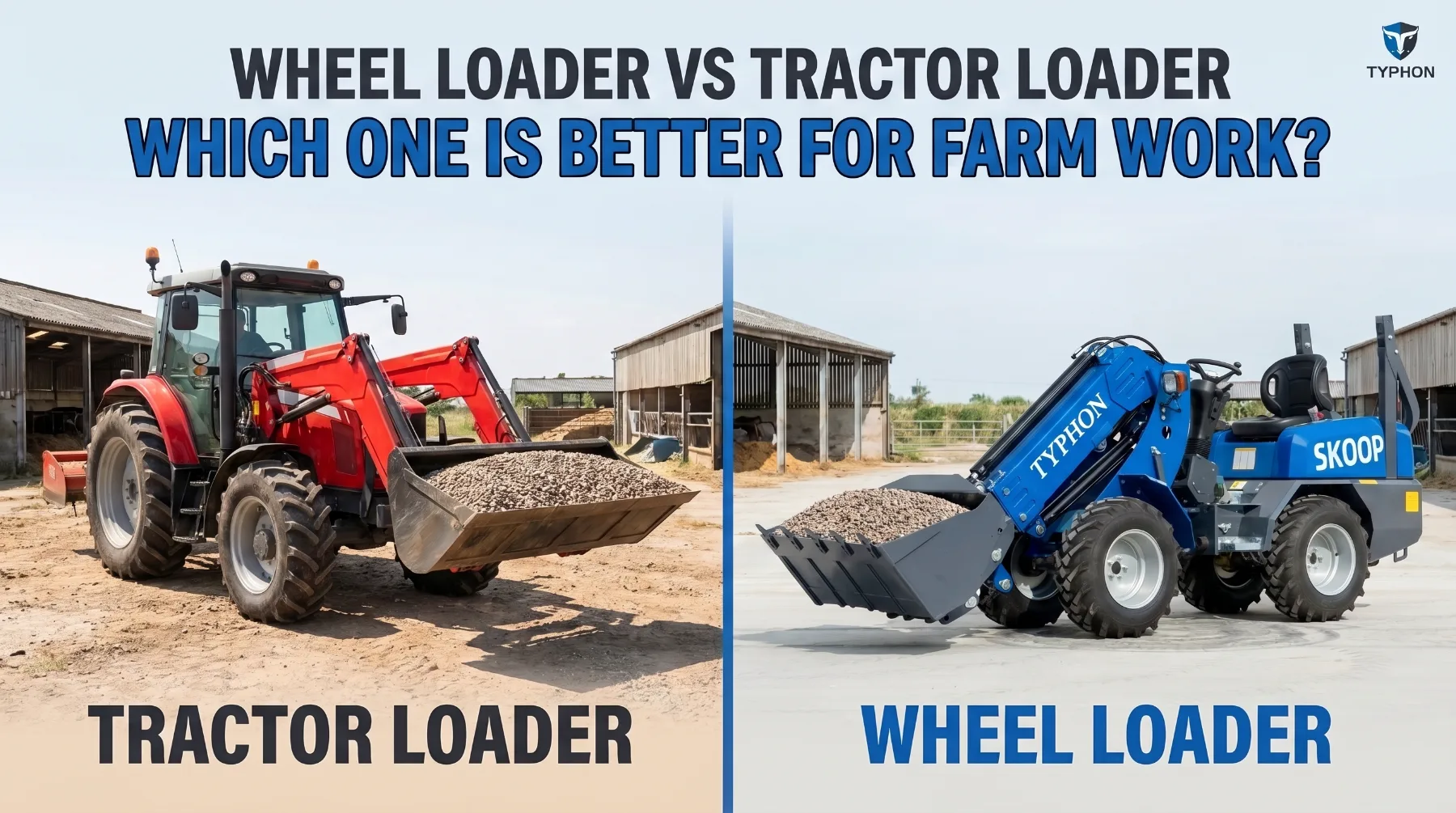
Choosing between a wheel loader and a tractor loader for farm work comes down to matching the machine to the tasks that fill your week, since each shines at different jobs. A tractor loader handles a broad spread of farm duties and doubles as a fieldwork machine, while a dedicated wheel loader moves and lifts heavy material faster than a tractor ever could. This guide walks through why the choice matters, how the two differ in maneuverability, lifting power, attachment range, running costs, and ground suitability, and how to land on the right machine for your farm. Here’s what to weigh before you commit.
Why the Machine You Pick Shapes Your Whole Operation
Productivity on a farm rises or falls with how well your equipment matches your daily tasks, so this decision reaches far past a single purchase. Pick a machine suited to your work, and chores that eat hours shrink to minutes, while the wrong choice leaves you fighting the equipment through jobs it was never built to handle. Getting the fit right up front shapes every season that follows.
Task variety is where the two machines split. A tractor loader spreads itself across loading, mowing, tilling, hauling, and towing, making it the backbone of a mixed operation, whereas a wheel loader concentrates its strength on scooping, carrying, and stacking heavy material at speed. Naming the work you repeat most tells you which strength matters more.
Cost and idle time ride on the match too. Buying a machine that sits unused between rare tasks ties up capital that a more versatile unit would keep earning, so weighing how often each job comes up protects your budget as much as your schedule.
Key takeaway: The machine you choose drives your farm’s productivity, so decide it against the tasks you repeat most. Match the equipment to the work, and daily chores speed up instead of dragging.
Getting Around Tight Barns and Open Fields
Maneuverability separates these machines the moment you put them to work in different spaces. Tractors turn sharply and thread through gates, barns, and narrow rows with ease, which suits the confined corners of a working farm where a large machine would clip walls and posts. Compact size and a tight turning circle keep a tractor loader productive where room runs short.
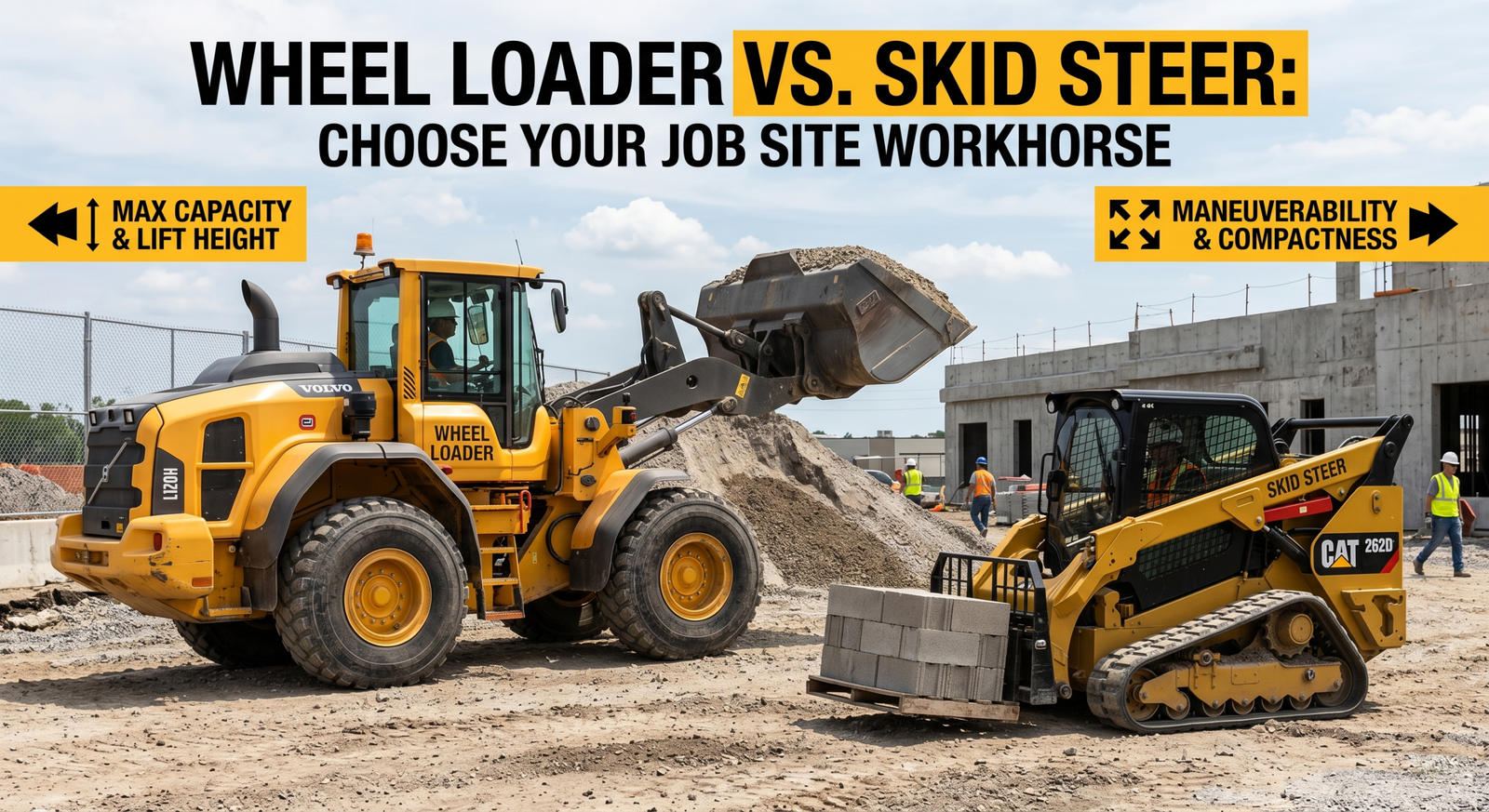
Wheel loaders trade some of that agility for a different kind of movement. Built around articulated steering that bends the machine at its center, a wheel loader pivots in surprisingly tight arcs for its size and travels quickly across open ground, so loading trucks in a yard or moving material across a large lot plays straight to its strengths. Speed over open distance is where it pulls ahead.
Access to your actual workspaces should settle the point. Measure the barns, gates, and passages the machine must clear daily, then picture it working inside them, since a unit that fits the yard but can’t reach the feed shed creates the same bottleneck as one too slow for the job.
What this means: A tractor loader wins in tight barns and rows, while a wheel loader moves faster across open yards and lots. Judge the spaces you work most, and let your daily access decide which agility matters.
Comparing Lifting Muscle and Load Capacity
Lifting power is where a wheel loader flexes its clearest advantage, since these machines are engineered around moving heavy material fast. A dedicated wheel loader carries a larger bucket, lifts more weight per cycle, and dumps higher into a truck bed than a tractor loader, so bulk jobs like loading grain, gravel, or manure finish in a fraction of the passes. Raw capacity and reach are the loader’s calling card.
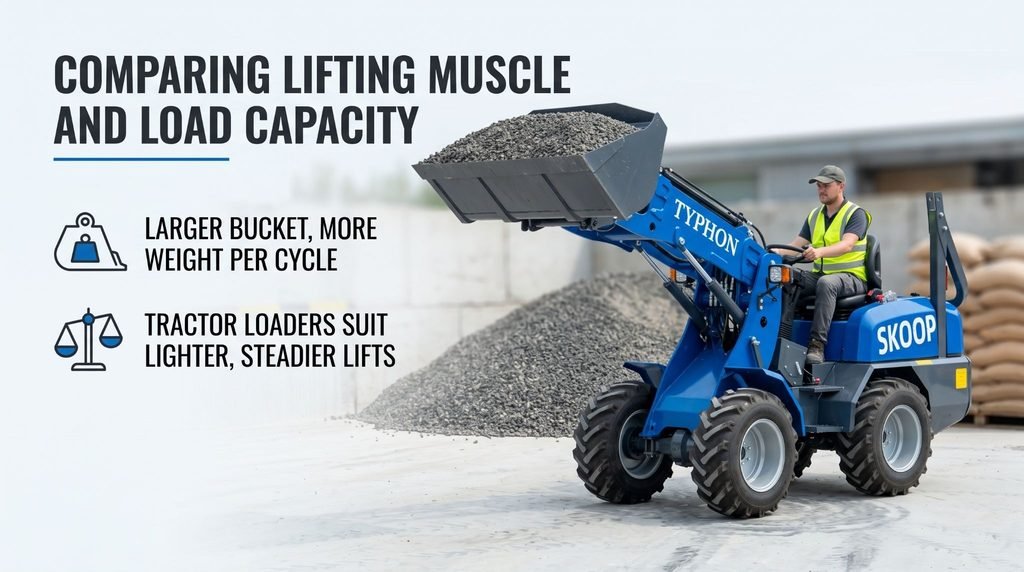
Tractor loaders lift respectable loads, yet they operate within tighter limits. Because the loader arms bolt onto a machine built primarily for pulling implements, the front-end capacity stays modest, and pushing heavy material repeatedly can strain the tractor and lift its rear wheels if the load runs too far forward. Steady, moderate lifting suits the tractor far better than constant heavy hauling.
Cycle speed compounds the capacity gap over a full day. Consider a farmer loading a large pile of feed: a wheel loader clears it in a handful of quick scoops, while a tractor takes many more passes and more time, so the difference stacks up across every heavy task you repeat.
Key takeaway: A wheel loader lifts more, dumps higher, and cycles faster on heavy material, while a tractor loader handles moderate loads within safer limits. Tally your heaviest, most frequent lifting to see which capacity your farm truly needs.
Running the Attachments Your Farm Depends On
Attachment range is where a tractor loader quietly outclasses its rival, thanks to the three-point hitch and power take-off that open a vast catalog of farm implements. Beyond the front bucket, a tractor runs mowers, tillers, balers, seeders, sprayers, post-hole augers, and dozens more tools, so one machine covers planting, harvesting, and maintenance across the whole season. Versatility like that is exactly why tractors anchor most farms.
Wheel loaders keep their attachment focus narrower but still useful. Fitted with a quick-attach coupler, a loader swaps between buckets, pallet forks, grapples, and material-handling tools, which serves heavy loading and stacking well, though it won’t run the ground-engaging field implements a tractor drives. Loading tasks suit it; fieldwork does not.
Your task list points to the winner here. Operations leaning on planting, mowing, and towing need the tractor’s implement range, while a farm centered on moving feed, bedding, and bulk material gains more from the loader’s material-handling tools.
What this means: A tractor loader runs the full spread of field and maintenance implements, while a wheel loader specializes in loading and material-handling attachments. Match the tools your season demands to the machine that carries them.
Weighing Fuel Burn and Ongoing Ownership Costs
Operating expense tips the scale differently depending on how hard you run each machine. Tractors generally sip less fuel during light and moderate work, and their broad service network keeps parts and repairs affordable and easy to source, so a mixed farm often finds the tractor cheaper to own across a year of varied chores. Everyday economy favors the tractor on lighter duty.
Wheel loaders burn more fuel but earn it back through speed on heavy work. When a job means moving large volumes of material, a loader finishes in far less time, so the higher hourly fuel cost spreads across fewer hours and less labor, which can undercut a tractor straining slowly through the same task. Efficiency on bulk work shows up in the clock, not just the fuel gauge.
Maintenance and lifespan round out the ownership picture. A tractor doing double duty as both loader and field machine racks up hours fast and wears its front loader under loads it wasn’t optimized for, while a dedicated wheel loader shrugs off heavy lifting it was built to endure, often lasting longer under that specific strain.
Key takeaway: A tractor loader usually costs less to run on light, varied work, while a wheel loader earns its higher fuel burn through speed on heavy jobs. Weigh your fuel, labor, and repair costs against the work you actually do.
Reading Your Ground and Weather Conditions
Terrain steers this choice as firmly as any spec, since each machine handles farm ground differently. Tractors travel confidently across fields, mud, and uneven pasture on large, aggressive tires built for traction, and four-wheel-drive models climb slopes and pull through soft soil that would bog a lighter machine. Rough, varied land plays to the tractor’s roots.
Wheel loaders perform best on firmer, more even surfaces. Their strength shows on yards, gravel lots, and compacted ground where they load and haul at speed, but soft, deeply rutted fields can challenge a heavy loader that wasn’t designed for constant off-road pulling. Solid footing lets the loader do its finest work.
Weather and surface protection deserve a thought too. A machine crossing wet pasture daily needs the traction and flotation a tractor provides, while a loader working a hard-surfaced yard avoids the rutting and sinking that soft ground invites, so picture the conditions your machine faces through every season, not just the dry ones.
What this means: A tractor loader handles rough, soft, and sloped farm ground with ease, while a wheel loader excels on firm yards and lots. Read the terrain and weather you work in, and let the ground guide your pick.
Landing on the Right Machine for Your Farm
Farm type points you toward the answer faster than any single spec, so start by picturing the operation you run. Mixed farms that plant, harvest, mow, and load reward the tractor loader’s all-around range, while operations built around constant heavy material handling, such as large feedlots or grain yards, gain more from a dedicated wheel loader’s speed and capacity. Naming your core work narrows the field immediately.
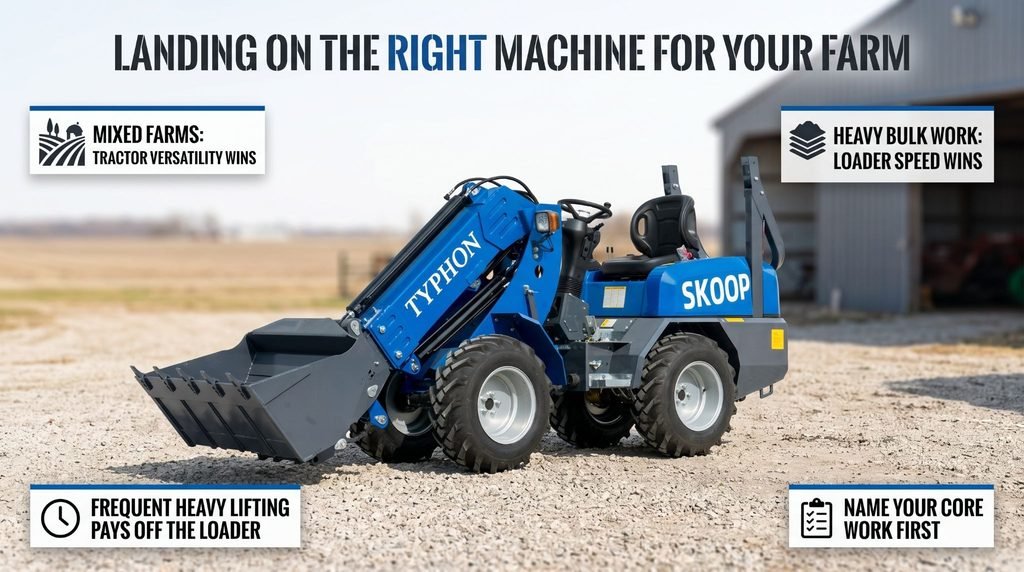
Volume and frequency of heavy lifting settle the question next. If moving bulk material fills much of your week, the loader’s faster cycles pay for themselves, whereas occasional heavy jobs mixed with fieldwork make the tractor’s versatility the smarter buy. Honest math on how often each task recurs keeps the choice grounded.
Budget and fleet strategy tie it together. A farm that can justify only one machine usually leans tractor for its breadth, while an operation with a tractor already earning its keep might add a wheel loader to shoulder the heavy hauling and spare the tractor’s front end. Weighing what you own against what you lack lands you on the right addition.
Key takeaway: Choose the tractor loader for versatile, mixed-farm work and the wheel loader for heavy, high-volume material handling. Match your farm type, your lifting frequency, and your budget to land on the machine that earns its keep.
Conclusion
Deciding between a wheel loader and a tractor loader for farm work comes down to matching the machine to the tasks that define your operation. A tractor loader delivers unmatched versatility, running a full range of field and maintenance implements, moving nimbly through tight barns and rows, and traveling confidently across soft, uneven ground, all while sipping less fuel on light work. A wheel loader trades that breadth for raw material-handling muscle, lifting more, dumping higher, and cycling faster on heavy jobs across firm yards and lots. Judge your farm honestly: name the work you repeat most, tally how often heavy lifting comes up, and weigh your terrain, your budget, and the machines you already own. Picture your daily chores and your heaviest task side by side, and the right choice grows clear. When you’re ready to put a dependable, well-matched machine to work on your farm, reach out to a trusted equipment specialist who can pair a reliable loader or tractor with the results your operation depends on.
Frequently Asked Questions
Is a wheel loader or a tractor loader better for a small mixed farm?
For most small mixed farms, a tractor loader is the stronger choice. Its three-point hitch and power take-off run a wide range of implements, so one machine handles loading, mowing, tilling, hauling, and towing across the whole season. A wheel loader lifts heavier material faster, but it can’t run the field implements a mixed farm relies on. Unless your operation centers on constant heavy material handling, the tractor’s versatility usually delivers more value on a small, varied farm.
Can a tractor loader handle heavy material like a wheel loader?
Not to the same degree. A tractor loader lifts respectable loads, but its front-end capacity stays modest because the arms bolt onto a machine built mainly for pulling implements. Pushing heavy material repeatedly can strain the tractor and lift its rear wheels if the load sits too far forward. A dedicated wheel loader carries a larger bucket, lifts more per cycle, and dumps higher, so bulk jobs finish in far fewer passes. For steady heavy hauling, the wheel loader is the safer, faster tool.
Which machine costs less to run on a farm?
It depends on the work. A tractor loader generally burns less fuel on light and moderate tasks, and its broad service network keeps parts and repairs affordable, so it often costs less across a year of varied chores. A wheel loader burns more fuel but finishes heavy jobs in far less time, so on bulk material work the higher hourly cost spreads across fewer hours and less labor. Weigh your fuel, labor, and repair costs against the tasks you actually repeat.