How Load Weight Affects Wheel Loader Engine Demand
Loading aggregate starts with a wheel loader pushing its bucket into a dense stockpile, filling it, and reversing before lifting the material clear. Although the cycle looks straightforward, the weight carried in the bucket affects nearly every movement that follows. A heavier payload increases the effort required to lift the load, accelerate, travel across the site, and climb grades. That added demand connects payload weight directly to engine and hydraulic workload, influencing the efficiency of each loading cycle.
Engine demand rises as the machine works harder to move greater loads. Hydraulic power is needed to raise and position the bucket, while engine output supports travel and maintains machine performance under load. Carrying more material per cycle can improve productivity when the loader is properly matched to the task, but excessive payloads can increase fuel use, component stress, and cycle times.
Across repeated loading cycles, maintaining a sensible payload helps balance productivity, fuel consumption, and machine workload. Operators can also improve efficiency by considering travel distance, terrain, stockpile conditions, and how the bucket is filled. Understanding the connection between payload weight and machine demand makes it easier to keep loading performance consistent without placing unnecessary strain on the loader.
What Happens as Load Weight Increases
A heavier bucket increases the total amount of work the machine has to perform, and that demand shows up across several systems at once. More weight means more engine power is needed simply to maintain travel speed, and that need climbs sharply when the loader works on an incline or pushes through soft, rutted, or otherwise difficult ground. What feels effortless with a light load can strain the machine with a heavy one.
The hydraulic system feels it too. As the load grows, so does the resistance the hydraulics must overcome to lift the bucket and linkage. The engine and hydraulics end up drawing on the same power source under the same heavier demand, which is why payload affects the machine as a whole rather than any single component in isolation.
Key takeaway: A heavier bucket raises the work required from both the engine and hydraulics, and that demand grows further on inclines or difficult ground.
Hydraulic Power During Lifting
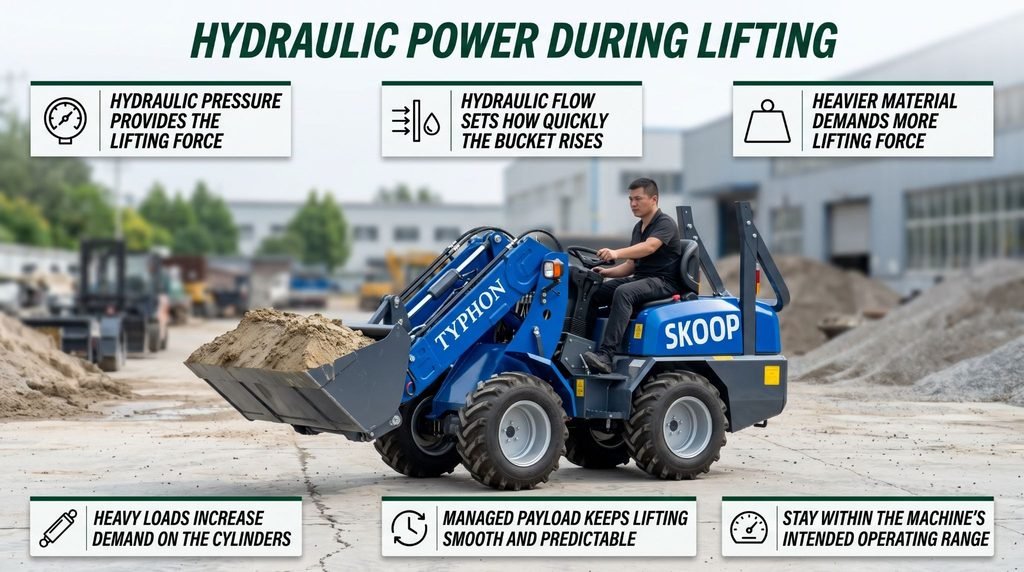
Raising a loaded bucket depends on the hydraulic system’s ability to generate enough force and maintain an appropriate lifting speed. The lift cylinders must move the combined weight of the bucket, material, and linkage, while hydraulic pressure and flow each play a different role. Pressure provides the force needed to lift the load, while hydraulic flow influences how quickly that movement takes place.
As the payload increases, the hydraulic system faces greater demand during each lifting cycle. Repeatedly operating with heavy loads can place continuous stress on the cylinders and hydraulic components, especially when working close to the machine’s operating limits. Matching the payload to the machine’s capabilities helps maintain controlled lifting performance and supports consistent operation over extended work periods.
- Hydraulic Pressure: Provides the force required for the lift cylinders to raise the loaded bucket.
- Hydraulic Flow: Influences how quickly the lift cylinders extend and the bucket moves upward.
- Payload Weight: Heavier material increases the force required from the lifting system.
- Lift Cylinder Demand: Greater loads place more demand on the cylinders during each lifting cycle.
- Cycle Consistency: Managing payload appropriately helps maintain smoother and more predictable lifting performance.
- Machine Capability: Keeping loads within the machine’s intended operating range helps reduce unnecessary hydraulic stress during repeated work.
Key takeaway: Lift cylinders need hydraulic pressure for force and flow for speed, and heavier loads increase hydraulic demand, especially across repeated cycles.
Travel Requires More Engine Output
Once the bucket is raised, the loader has to move the combined weight of the machine and its material to the dump or truck. That combined mass is what the drivetrain must accelerate and, where the route climbs, carry uphill. A heavier load increases the effort required for both, so the engine works harder to reach travel speed and harder still to hold it on a grade.
Travel demand isn’t set by weight alone, though. Traction determines how much of the engine’s power actually reaches the ground, and that depends on tire condition, the surface underfoot, and drivetrain performance. Worn tires or loose, wet ground waste power to slippage, forcing the engine to work harder for the same movement. Reading these factors together gives a truer picture of travel demand than payload on its own.
Key takeaway: Moving the combined machine and material weight raises engine output for acceleration and climbing, with traction, tires, surface, and drivetrain all shaping the demand.
Load Weight and Fuel Consumption
Engine workload and fuel consumption move together, so when a loader repeatedly handles heavy loads or works against high resistance, fuel use tends to rise. Each demanding cycle draws more from the engine than a lighter one, and over a full shift of repeated loading, that difference adds up. A machine consistently pushed near its limits will generally burn more fuel than one working within a comfortable range.
The encouraging part is how much of this responds to operating practice. Efficient bucket filling that captures a full, proper load in fewer passes, sensible travel distances that avoid unnecessary ground, and smooth, deliberate operation all reduce wasted engine demand. Sharp acceleration, spinning tires, and repeated repositioning burn fuel without moving material, so trimming them protects both consumption and productivity.
Key takeaway: Heavier loads and high resistance raise engine workload and fuel use, but efficient filling, suitable travel distances, and smooth operation help reduce unnecessary demand.
Matching Bucket Capacity to Material
Bucket capacity should suit both the machine and the density of the material being handled, and density is where many payload problems begin. The same bucket filled with a dense material carries a substantially heavier load than when filled with a lighter one, so a bucket sized correctly for light material can produce an overweight payload the moment it’s packed with something denser. Volume tells you how much fits; density tells you how much it weighs.
Matching bucket size to material density keeps the loader within its intended operating range, where the engine and hydraulics work as designed rather than fighting a constant overload. That match protects the machine and steadies your cycles. When you take on a denser material, consider whether the bucket you’re using still produces a payload the machine is built to handle, rather than assuming the same bucket suits every job.
Key takeaway: The same bucket holds far more weight when filled with dense material, so match bucket size to material density to keep the loader within its intended operating range.
Operating Conditions Change Demand
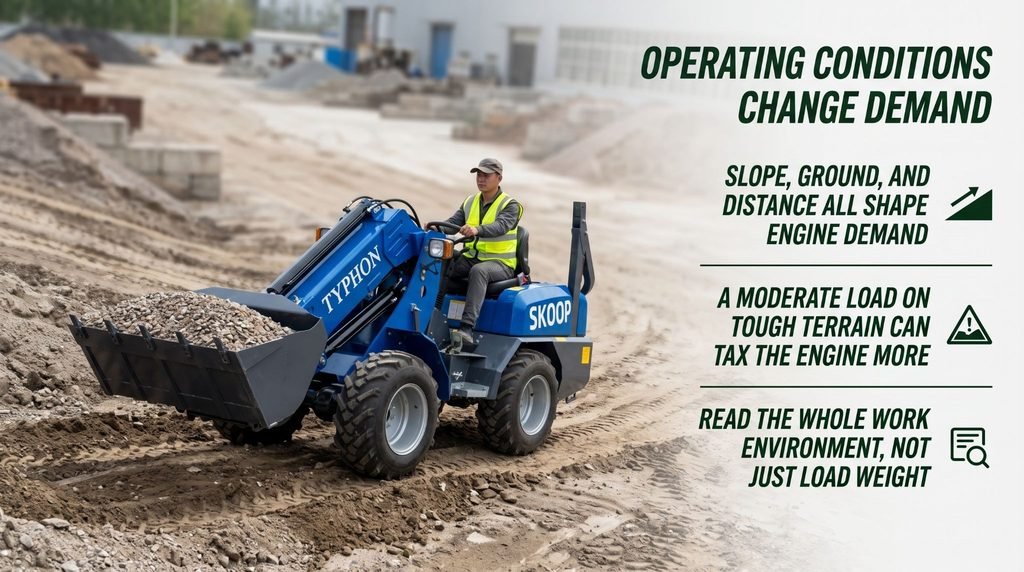
Payload is only one input into engine workload, because the working environment shapes demand just as strongly. Slope, ground conditions, travel distance, material density, and loading frequency all shift how hard the machine has to work. A loader moving heavy aggregate uphill faces a very different demand from one carrying a lighter load across level, firm ground, even if the machine is identical.
That’s why the complete working environment deserves consideration, not load weight alone. A moderate load on a long uphill haul with soft ground and rapid cycle times can tax the engine more than a heavier load on a short, level, well-surfaced route. Reading slope, surface, distance, density, and frequency together lets you anticipate real demand and adjust before the machine is overworked rather than after.
Key takeaway: Slope, ground conditions, travel distance, material density, and loading frequency all change engine workload, so weigh the full environment rather than payload alone.
Conclusion
Wheel loader engine demand increases as the machine handles heavier loads because lifting, accelerating, traveling, and hydraulic functions require additional power throughout the work cycle. Load weight affects hydraulic demand during lifting and bucket positioning, while moving the combined machine and payload increases drivetrain and traction requirements, particularly on slopes, soft ground, or surfaces with high rolling resistance. Hydraulic cylinder force depends on system pressure, while cylinder speed depends largely on hydraulic flow, so repeated heavy lifting cycles can increase both power demand and heat generation. Material density is also important because the same bucket volume can produce significantly different payload weights, making bucket capacity and rated payload dependent on the material being handled. Repeated operation near the machine’s rated limits can increase fuel consumption and component loading, while properly filled buckets, smooth acceleration, suitable travel speeds, and efficient cycle patterns can reduce unnecessary energy use. Matching payload, bucket capacity, material density, tire condition, ground conditions, slope, travel distance, and cycle frequency to the loader’s rated capabilities helps maintain productive performance without placing unnecessary strain on the powertrain and hydraulic system.
Frequently Asked Questions
Does a heavier bucket require more engine power?
Generally, yes. A heavier payload increases the effort needed for lifting, acceleration, and travel. The engine powers the hydraulic system during lifting and also moves the combined machine and load. Inclines and difficult ground increase this demand further. Keeping payload within the loader’s rated range helps maintain performance and reduce unnecessary wear.
How does load weight affect hydraulic demand?
A heavier bucket requires more hydraulic force from the lift cylinders to raise the material, bucket, and linkage. Hydraulic pressure provides the lifting force, while flow controls how quickly the movement occurs. Repeated heavy lifts create a much greater workload over a full shift, so matching payload to the machine’s hydraulic capacity helps prevent continuous operation near system limits.
Can load weight increase fuel consumption?
Yes. Heavier loads increase engine workload and can raise fuel consumption, especially during repeated cycles, uphill travel, or work on soft ground. Efficient bucket filling, shorter travel distances, and smooth acceleration help reduce unnecessary engine demand. Keeping cycles productive rather than aggressive can also improve fuel efficiency.
Why does material density matter?
Material density determines how much a bucket weighs when filled. Gravel and rock can create a much heavier payload than lighter materials in the same bucket. A bucket suitable for light material may overload the machine when used for dense material, increasing engine and hydraulic demand. Match bucket capacity to both the material density and the loader’s rated payload.