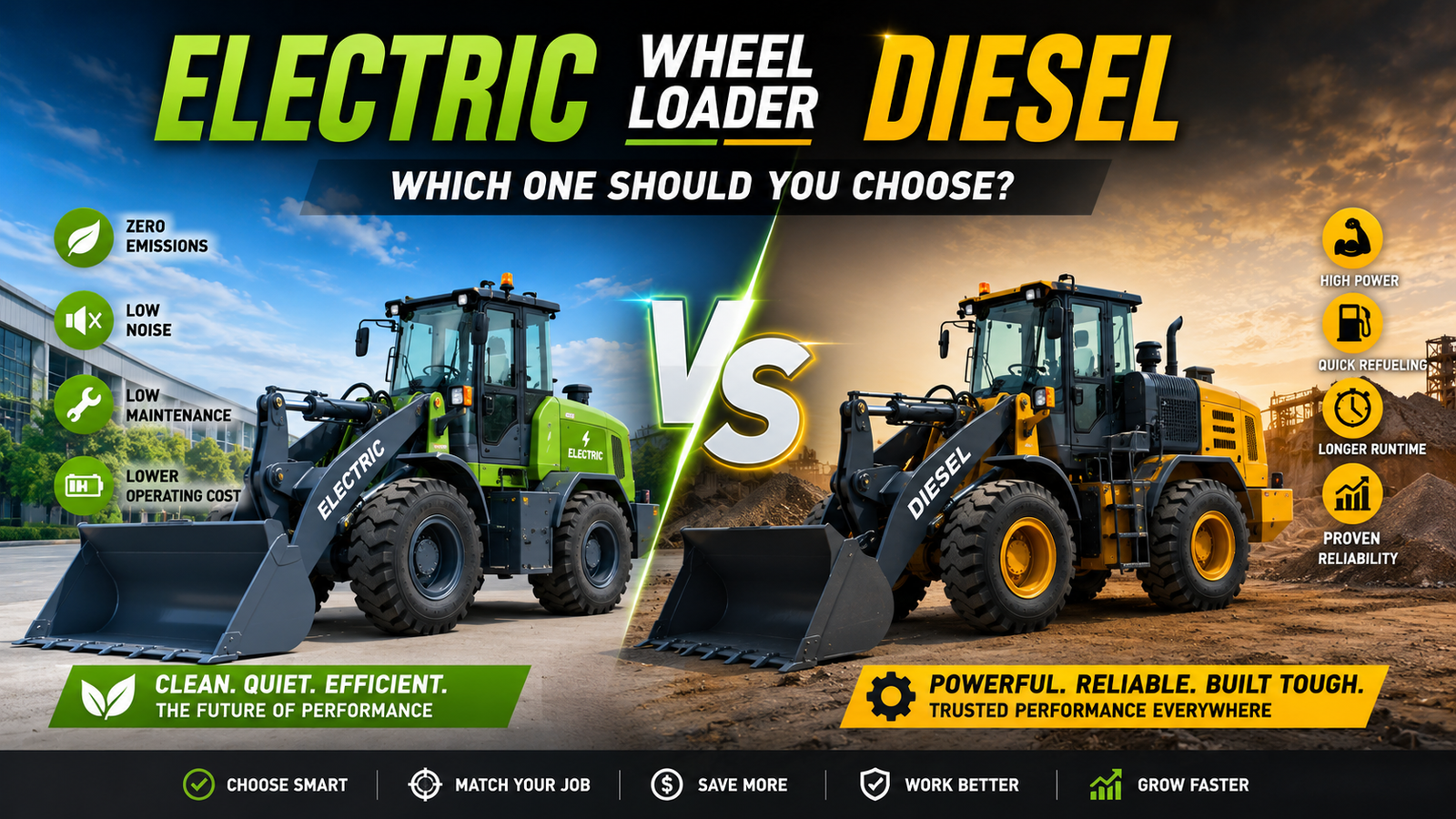
Electric Wheel Loader vs Diesel Wheel Loader: Which One Is Better?
Choosing between an electric wheel loader and a diesel wheel loader is becoming a more important decision for equipment buyers. In the past, most wheel loaders used diesel engines because diesel power was the normal choice for heavy equipment. Today, electric wheel loaders are becoming more common, especially in compact equipment, indoor work areas, urban jobsites, warehouses, farms, and places where lower noise and lower emissions are important.
But this does not mean electric wheel loaders are automatically better than diesel wheel loaders. It also does not mean diesel wheel loaders are outdated. Both machines have strong advantages. Both can be useful. The right choice depends on your worksite, operating hours, lifting needs, budget, charging access, maintenance plan, and long-term business goals.
A diesel wheel loader is still a strong choice for heavy-duty work, long operating days, remote jobsites, and buyers who need proven power with fast refueling. An electric wheel loader can be a smart choice for indoor work, low-noise areas, cleaner operation, lower routine maintenance, and businesses that want a modern machine for lighter to medium-duty material handling.
This guide explains the difference between electric and diesel wheel loaders in simple English, so buyers can make a practical decision before investing in a machine.
What Is an Electric Wheel Loader?
An electric wheel loader is a wheel loader powered by an electric motor and battery system instead of a diesel engine. It still works like a normal wheel loader. It has wheels, a front loader arm, a bucket or attachment system, hydraulic lifting power, and a cab or operator station. The main difference is the power source.
Instead of filling the machine with diesel fuel, the operator charges the battery. Once charged, the electric motor provides power to move the machine and operate the hydraulic system. Some electric wheel loaders are compact machines designed for small construction sites, indoor areas, farms, warehouses, landscaping yards, and city projects. Larger electric loaders exist too, but compact electric machines are usually the most common choice for buyers looking at electric equipment.
The main benefit of an electric wheel loader is cleaner and quieter operation. Since there is no diesel engine running, the machine produces less noise and no direct exhaust from the engine during use. This can be very helpful in indoor areas, residential zones, greenhouses, warehouses, food-related facilities, and jobsites where workers are close to the machine.
Electric wheel loaders can also feel smoother to operate. Electric motors can deliver quick response, and there are fewer engine-related parts compared with diesel machines. This may reduce some routine maintenance needs, especially oil changes and engine-related service.
However, an electric wheel loader depends heavily on battery size, charging time, charger access, and daily working hours. If the jobsite does not have reliable charging, or if the machine must work long shifts without stopping, an electric loader may not be the best choice.
What Is a Diesel Wheel Loader?
Diesel engines are popular in heavy equipment because they provide strong torque, long working time, and reliable performance in demanding environments. A diesel wheel loader can work for long hours, refuel quickly, and return to work with little downtime. This makes diesel machines practical for busy jobsites where the loader is used all day.
A diesel wheel loader is often the better choice for heavy-duty outdoor work. If the machine needs to load gravel, soil, sand, rock, debris, pallets, or construction material for many hours, diesel power is still very dependable. It is also easier to use on remote jobsites because diesel fuel can be brought to the machine, while charging an electric loader may be harder if there is no power source nearby.
The downside is that diesel wheel loaders produce exhaust, make more noise, and need engine maintenance. They require fuel, engine oil, filters, belts, cooling system checks, and other service tasks. Fuel cost can also become a major long-term expense, especially if the machine works many hours per week.
A diesel wheel loader is not always the cleanest or quietest option, but it remains a powerful and practical choice for many businesses.

Electric Wheel Loader vs Diesel Wheel Loader: Main Difference
The main difference between an electric wheel loader and a diesel wheel loader is the power source.
An electric wheel loader uses a battery and electric motor. A diesel wheel loader uses a diesel engine. This difference affects almost everything else, including operating cost, maintenance, noise, emissions, runtime, refueling, charging, jobsite planning, and long-term ownership.
Electric wheel loaders are usually better when the job needs quiet operation, clean indoor use, lower routine maintenance, and shorter or controlled work shifts. Diesel wheel loaders are usually better when the job needs long runtime, heavy-duty performance, fast refueling, and strong reliability in remote outdoor environments.
The simple way to think about it is this: electric wheel loaders are strong for controlled jobsites, indoor or urban work, and lower-noise material handling. Diesel wheel loaders are strong for long days, tough outdoor work, and jobs where downtime must be very low.
This does not mean one is always better than the other. A small warehouse or landscaping yard may benefit more from an electric wheel loader. A road construction company or quarry operation may still need a diesel wheel loader. The right machine depends on the real job.
Power and Performance Comparison
Power is one of the first things buyers think about when comparing electric and diesel wheel loaders. Many people assume diesel is always stronger, but the answer depends on machine size and job type.
Diesel wheel loaders are proven for heavy-duty work. They can handle demanding loading cycles, rough ground, long operating hours, and large material volumes. For large machines and tough jobs, diesel power is still very common because it provides strong performance and long working range.
Electric wheel loaders can also deliver strong performance, especially in compact sizes. Electric motors can provide quick torque, which means the machine can respond smoothly when moving, lifting, or pushing into material. For light to medium-duty loading, electric wheel loaders can feel very capable.
However, battery size and machine design matter a lot. A compact electric wheel loader may work well for pallets, mulch, soil, feed, snow, and light construction materials. But it may not be the right choice for heavy rock, large-scale roadwork, or all-day high-volume loading.
Diesel machines are usually better for continuous heavy work. Electric machines can be excellent for controlled jobs, but buyers must carefully check rated load, bucket capacity, hydraulic performance, operating weight, battery capacity, and expected runtime.
Do not choose based only on the word “electric” or “diesel.” Compare the actual specifications. A strong compact electric loader may outperform a weak small diesel loader in some tasks. A large diesel loader may easily outperform a small electric loader in heavy work. The machine size and design matter as much as the power source.
Runtime, Refueling, and Charging
Runtime is one of the biggest differences between electric and diesel wheel loaders.
A diesel wheel loader can usually work for many hours as long as it has fuel. When the fuel tank is low, the operator can refuel the machine quickly and continue working. This is a major advantage for busy jobsites. If the machine works all day, diesel refueling is simple and fast.
An electric wheel loader depends on battery capacity. Once the battery gets low, the machine needs to be charged. Charging can take time depending on the charger, battery size, and power supply. Some electric loaders may support faster charging, but charging is still not the same as filling a diesel tank in a few minutes.
This means electric wheel loaders need better planning. Buyers must think about how many hours the machine will work each day, when it can charge, where the charger will be placed, and whether the site has enough electrical power. If the machine works only a few hours per day, charging overnight may be enough. If the machine works long shifts, charging may become a problem unless the business has a strong charging plan.
For indoor warehouses, farms, municipal sites, and yards with a fixed base, charging is easier. The machine can return to the same location and charge after work. For remote construction sites, roadwork, or temporary job locations, charging can be more difficult.
Diesel wheel loaders are better when refueling speed and long runtime are critical. Electric wheel loaders are better when the job has predictable work hours and reliable charging access.
Maintenance and Service Needs
Electric wheel loaders usually have fewer engine-related maintenance needs than diesel wheel loaders. Since there is no diesel engine, there is no engine oil change, fuel filter replacement, diesel exhaust system maintenance, or some other engine service tasks. This can reduce routine maintenance time and may lower some long-term service costs.
Electric machines still need maintenance. The battery system, electric motor, hydraulic system, tires, brakes, pins, bushings, loader arms, bucket, attachments, and cooling systems still need inspection. Operators still need to grease moving parts, check hydraulic fluid, inspect tires, and keep the machine clean.
The advantage of diesel is that many mechanics already understand diesel equipment. Parts, service knowledge, and repair routines are widely available. For electric machines, buyers should make sure the dealer or supplier can support the battery, controller, motor system, and electrical components.
This is very important. An electric wheel loader may have fewer routine service needs, but if something goes wrong with the battery or electric system, the buyer needs proper technical support. A diesel loader may need more regular maintenance, but repair knowledge may be easier to find in many areas.
For long-term ownership, support matters as much as the machine type. Before buying, ask about parts availability, warranty, service support, battery warranty, charger support, and repair options.
Fuel Cost vs Electricity Cost
Operating cost is another major part of the electric wheel loader vs diesel wheel loader decision.
Diesel wheel loaders use fuel every day. The more the machine works, the more fuel it burns. Fuel cost can become expensive over time, especially for businesses that run machines many hours per week. Diesel prices can also change, which makes cost planning harder.
Electric wheel loaders use electricity instead of diesel fuel. In many cases, electricity can cost less than diesel for daily operation, especially if the machine charges at a business location with stable power pricing. This can help reduce running cost over time.
However, the full cost is not only fuel or electricity. Buyers must also consider purchase price, charger cost, battery replacement cost, maintenance, downtime, parts, warranty, and resale value. An electric wheel loader may cost more upfront in some cases, but may save money on fuel and routine maintenance. A diesel wheel loader may be cheaper or easier to service in some markets, but fuel and maintenance costs can add up.
The best way to compare cost is to estimate real usage. Think about how many hours the loader will work per day, how many days per week, how much diesel costs in your area, how much electricity costs, and what service support is available.
A machine that looks cheaper on day one may not be cheaper after five years. A machine that looks expensive at first may save money if it matches the job perfectly and has lower daily running cost.

Noise and Operator Comfort
Electric wheel loaders are usually quieter than diesel wheel loaders. This is one of their biggest advantages.
A quieter machine can improve comfort for operators and workers nearby. It can also make communication easier on the jobsite. In indoor spaces, residential neighborhoods, farms, schools, hospitals, warehouses, and city work areas, lower noise can be a major benefit.
Diesel wheel loaders make more engine noise. For outdoor heavy-duty jobs, this may not be a big problem. Many construction sites are already noisy. But in areas where noise control matters, diesel machines can be harder to use.
Electric machines can also reduce vibration related to engine operation. This may make the machine feel smoother and more comfortable, especially during short loading cycles or indoor use.
That said, operator comfort depends on more than power source. Seat quality, cab design, visibility, controls, suspension, heating, cooling, and machine stability all matter. A well-designed diesel loader may be more comfortable than a poorly designed electric loader. A well-designed electric loader may feel smoother and easier for daily use.
When choosing, buyers should test the machine if possible. Sit in the operator position. Check visibility. Check control response. Listen to the noise level. Look at how easy it is to attach tools, dump material, and move around the work area.
Emissions and Indoor Use
Electric wheel loaders have a strong advantage for indoor use because they do not produce direct diesel exhaust while operating. This makes them useful in warehouses, factories, greenhouses, food handling areas, enclosed yards, and other places where air quality matters.
Diesel wheel loaders produce exhaust, so they are usually better for outdoor use or well-ventilated areas. Using diesel equipment indoors can create air quality and safety concerns if the area is not properly ventilated.
For businesses that work inside buildings or near people, electric machines can be a smart choice. They can help keep the work environment cleaner and more comfortable. They can also help businesses meet jobsite rules where low-emission equipment is preferred or required.
For outdoor construction, farms, quarries, roadwork, and open jobsites, diesel emissions may be less of a daily concern, although fuel use and exhaust still matter.
If your wheel loader will work indoors often, electric should be seriously considered. If your wheel loader will work mostly outdoors in rough conditions, diesel may still be more practical.
Best Jobs for Electric Wheel Loaders
Electric wheel loaders are best for jobs where the work is predictable, the jobsite has charging access, and lower noise or cleaner operation is important.
They can be a good fit for warehouses, indoor material handling, farms, landscaping yards, nurseries, greenhouses, municipal work, residential areas, schools, resorts, and small construction sites. They are also useful for businesses that work in places where noise control matters.
An electric wheel loader can move pallets, soil, mulch, gravel, compost, feed, snow, light debris, and other materials. With the right attachments, it can handle forks, buckets, sweepers, snow tools, and other light to medium-duty tasks.
Electric loaders are especially practical when the machine returns to the same base every day. For example, a warehouse yard, farm, or material supply yard can charge the machine overnight. This makes daily planning easier.
They are also useful for businesses that want a cleaner image or want to reduce fuel use. For customer-facing properties like resorts, schools, parks, and commercial facilities, a quiet electric loader can look more modern and professional.
The key is to match the machine to the workload. Electric loaders are not always meant to replace large diesel loaders in heavy production work. They are strongest when the job fits their battery range, size, and charging plan.
Best Jobs for Diesel Wheel Loaders
Diesel wheel loaders are best for long workdays, heavy outdoor use, rough jobsites, remote areas, and high-volume material handling.
They are a strong choice for construction sites, road projects, farms, quarries, recycling yards, snow removal, land clearing support, and large material yards. If the machine needs to work for many hours with little downtime, diesel is still very practical.
Diesel loaders are also better when charging is not available. On remote land, road jobs, temporary construction sites, and open fields, diesel fuel can be easier to manage than electricity. A fuel truck or fuel container can keep the machine running without needing a fixed charging station.
For heavy loading, diesel wheel loaders are still trusted because they are proven in difficult conditions. They can work in mud, dust, heat, cold, and long shifts when properly maintained.
A diesel wheel loader is also a safe choice for buyers who want familiar service support. Many operators and mechanics already understand diesel machines, which can make repair and maintenance easier.
If the machine is your main production tool and downtime is expensive, diesel may be the better choice unless you have a strong electric charging and support system ready.
Jobsite Planning and Practical Use
The electric wheel loader vs diesel wheel loader decision is not only about the machine. It is also about the jobsite.
For an electric wheel loader, the jobsite needs a charging plan. You need to know where the machine will charge, how long charging will take, whether the power supply is strong enough, and whether the machine can finish its daily work on one charge. You also need a safe place for charging and cable management.
For a diesel wheel loader, the jobsite needs fuel planning. You need to store or deliver diesel safely, track fuel use, and maintain the engine. Refueling is faster, but fuel storage and fuel cost are still part of the work.
Electric machines may be easier in fixed locations. Diesel machines may be easier in changing locations. If your loader stays at one warehouse, farm, or yard, electric can be simple. If your loader moves between jobsites often, diesel may be easier.
Transport also matters. Some compact electric wheel loaders may be easy to move with a trailer, depending on weight and local rules. Diesel loaders also vary widely in transport needs. Always check machine weight, trailer capacity, transport rules, and loading height before buying.
The best machine is not only the one with good specs. It is the one that fits your daily workflow without creating new problems.
Resale Value and Long-Term Ownership
Resale value is harder to predict with electric wheel loaders because the market is still developing in many areas. Diesel wheel loaders have a long history, and used diesel equipment is widely understood. Buyers know how to inspect hours, engine condition, hydraulics, tires, and wear points.
Electric machines may hold value well if demand grows and the battery condition is strong. But buyers may also ask more questions about battery life, charger condition, software, electronic parts, and service history. Battery health may become one of the most important resale factors.
For diesel wheel loaders, engine hours and maintenance records are very important. A well-maintained diesel machine can remain useful for a long time. Poor maintenance, hard use, and worn hydraulics can reduce value.
For electric wheel loaders, battery condition and support history will matter a lot. Buyers should keep service records, charging records if available, and warranty documents. A machine with clear maintenance history is easier to resell.
If you plan to keep the machine for many years, resale value may be less important than operating cost and reliability. If you plan to upgrade often, consider which machine type has stronger demand in your market.
Which One Is Better for Small Contractors?
For small contractors, the right choice depends on the type of jobs they take.
If the contractor works mostly on residential projects, indoor jobs, landscaping support, small material handling, and quiet neighborhoods, an electric wheel loader can be attractive. It can reduce noise, avoid direct exhaust, and make the jobsite feel cleaner.
If the contractor works on road jobs, rough construction sites, land clearing support, heavy loading, or long outdoor days, a diesel wheel loader may be better. It gives longer runtime, fast refueling, and proven performance in tough conditions.
Small contractors also need to think about downtime. If the electric loader runs out of battery during the day and there is no fast charging plan, work may stop. If the diesel loader needs fuel, it can usually be refueled quickly.
For a small contractor with predictable jobs and charging at home base, electric can work well. For a contractor with unpredictable jobs and long workdays, diesel may be safer.
Which One Is Better for Farms?
Farms can benefit from both electric and diesel wheel loaders.
An electric wheel loader can be useful for barns, greenhouses, livestock areas, feed movement, indoor storage areas, and daily yard tasks. Lower noise can be helpful around animals and workers. No direct exhaust can also be useful in enclosed areas.
A diesel wheel loader can be better for large farms, outdoor material handling, long workdays, rough ground, manure handling, gravel work, and field support. If the machine needs to work far from a charging point, diesel is more practical.
For a farm with good electrical access and daily short material-handling tasks, electric can be a smart choice. For a farm that needs long hours and remote work, diesel is usually safer.
The farm should look at real daily work. If the loader works mostly near buildings and returns to the same place every night, electric is easier. If the loader works across large land and long hours, diesel is easier.
Which One Is Better for Warehouses and Indoor Yards?
For warehouses and indoor yards, electric wheel loaders often make more sense.
Indoor spaces need cleaner air and lower noise. Electric wheel loaders do not produce direct diesel exhaust during operation, which makes them better for enclosed areas. They can also be easier to use around workers because the noise level is lower.
A diesel wheel loader can still work in open outdoor yards, but it may not be ideal inside buildings. Exhaust and noise can become problems, especially if people work nearby.
For a warehouse, recycling facility, supply yard, or indoor material handling area, an electric wheel loader can be a strong choice if the lifting capacity and runtime match the job. Charging is also easier because the machine usually stays at the same location.
Which One Is Better for Heavy Construction?
For heavy construction, diesel wheel loaders are still usually the safer choice.
Heavy construction often needs long runtime, strong lifting power, large buckets, rough ground performance, and fast refueling. Diesel machines are already proven in this environment. They can work long shifts and handle demanding material movement.
Electric wheel loaders may still work on some construction sites, especially for compact tasks, indoor construction, low-noise requirements, or city projects with shorter work cycles. But for heavy production loading, diesel is still more common.
This may change over time as electric machine technology improves. But for now, buyers should be practical. If the loader is expected to work hard all day in tough conditions, diesel may be the better investment.
Common Mistakes When Choosing Between Electric and Diesel
One common mistake is choosing electric only because it sounds modern. Electric equipment can be excellent, but only when the charging plan, runtime, machine size, and jobsite conditions fit. Without charging access, an electric loader can become frustrating.
Another mistake is choosing diesel only because it feels familiar. Diesel machines are strong, but they are not always the best choice for indoor work, quiet areas, or businesses trying to reduce fuel use. A diesel loader may cost more to run if the work is light and predictable.
Some buyers also ignore total cost. They only look at purchase price. This is risky. Fuel, electricity, maintenance, downtime, battery life, parts, and resale value all matter.
Another mistake is not checking support. Whether electric or diesel, the machine needs parts and service. For electric loaders, battery and electrical support are very important. For diesel loaders, engine and hydraulic service support are important.
The best decision comes from matching the machine to the job, not following a trend.
Electric Wheel Loader vs Diesel Wheel Loader: Which One Should You Choose?
Choose an electric wheel loader if your work is mostly light to medium-duty material handling, your jobsite has reliable charging, and you care about lower noise, cleaner operation, and reduced routine engine maintenance. Electric loaders can be a smart choice for warehouses, indoor yards, farms, landscaping businesses, nurseries, municipalities, residential work, and controlled jobsites.
Choose a diesel wheel loader if your work is heavy-duty, outdoor, remote, long-hour, or high-volume. Diesel loaders are better for construction sites, roadwork, farms with large land, quarries, recycling yards, snow removal, and jobs where fast refueling and long runtime are important.
The simplest rule is this: choose electric if your jobsite is controlled and charging is easy. Choose diesel if your work is heavy, remote, or needs long runtime.
Neither machine is perfect for every buyer. Electric wheel loaders are cleaner and quieter, but they need charging planning. Diesel wheel loaders are powerful and easy to refuel, but they produce exhaust, make more noise, and need more engine maintenance.
The right choice is the one that helps your business work faster, safer, and more profitably.
Conclusion
The electric wheel loader vs diesel wheel loader comparison is not about which machine is better in every situation. It is about which machine is better for your work.
Electric wheel loaders are a strong option for buyers who need quiet operation, clean indoor use, predictable daily tasks, and lower routine engine maintenance. They can be excellent for warehouses, farms, landscaping yards, greenhouses, municipalities, and residential work areas.
Diesel wheel loaders are still the better choice for heavy outdoor work, long shifts, remote jobsites, and high-volume loading. They offer fast refueling, proven performance, and strong support in demanding environments.
Before buying, look at your daily work honestly. Think about runtime, charging, fuel cost, maintenance, lifting needs, attachments, jobsite conditions, and service support. Do not choose based only on trend or tradition. Choose based on what the machine must do every day.
For many buyers, diesel will still be the practical choice. For others, electric will be the smarter long-term move. The best machine is the one that fits your work, your site, and your budget.