
What Should You Check Before Buying a Used Scissor Lift?
A small maintenance contractor finds a used scissor lift listed well below market, likes the low hours on the meter, and wires a deposit that afternoon without ever putting a wrench near the machine. Delivery day arrives, the lift rises halfway, then drifts back down on its own as a tired cylinder bleeds off pressure, and a closer look reveals a hairline crack welded over on one of the scissor arms. Repairs run him nearly what a sound machine would have cost, and the lift sits idle for three weeks while parts trickle in. Nothing about buying used is a mistake by itself. Skipping the checks that reveal a machine’s real condition is what turned a bargain into a money pit, and a careful hour of inspection would have flagged every problem before a dollar changed hands.
Buying a used scissor lift well comes down to verifying the machine’s real condition before you commit, not trusting a clean coat of paint or a low asking price. A unit that looks sharp on the lot can hide worn cylinders, a stressed frame, or missing safety gear that surfaces the moment you put it to work. This guide walks through the checks that protect your money:
- Why a thorough pre-purchase inspection pays off
- Examining the frame and scissor arms for damage
- Testing the hydraulic system and cylinders
- Confirming the platform and safety features work
- Reviewing service records and the hour meter
- Running the machine before you commit
Here’s how to judge a used lift with confidence.
Why a Careful Look Beats a Blind Deal
Inspection separates a smart used purchase from an expensive gamble, since the seller knows the machine’s history and you don’t. A lift that starts and lifts on the lot can still carry hidden wear that fails weeks later, so the only way to protect yourself is to verify the condition rather than assume it. Trusting the asking price alone leaves you exposed to problems the seller may not mention.
Repair costs are what a skipped inspection quietly hands you. A failed cylinder, a cracked frame member, or a dead battery pack can each cost a large share of the purchase price, so a bargain that needs three of those repairs was never a bargain at all. Spotting trouble before you pay lets you walk away or negotiate rather than inherit someone else’s neglect.
Safety rides on the same checks that protect your wallet. A scissor lift raises people to height, so a worn part that fails in the air threatens far more than your budget, which makes a thorough look a matter of protecting your crew as much as your money. Verifying condition up front guards both.
Key takeaway: A careful pre-purchase inspection reveals the wear a low price hides, protecting your budget and your crew alike. Verify the machine’s real condition before you pay, and you buy a working lift rather than a repair bill.
Sizing Up the Frame and Scissor Arms
Structure is where the costliest problems hide, so start by examining the frame and the scissor arms closely. Cracks, bends, and rust weaken the very parts that hold a raised platform steady, and a compromised member can fail under load, so run your eyes and hands across every joint and beam. Damage here rarely shows from a distance but tells you plainly whether the machine has been overloaded or abused.
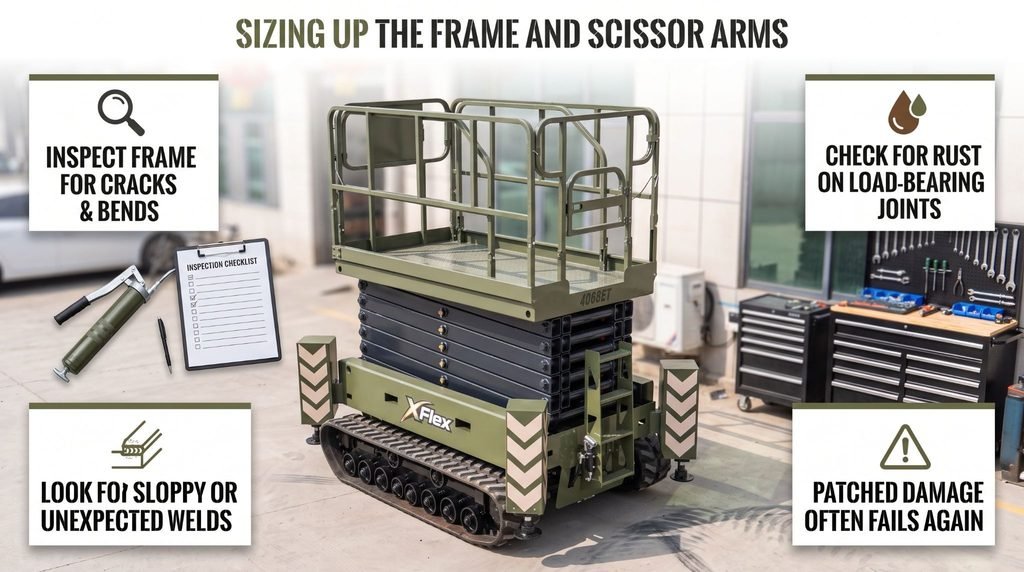
Welds deserve a hard look, since amateur repairs often signal a hidden history. Fresh or sloppy welds on the scissor arms or frame suggest a past failure someone patched rather than replaced properly, so treat any repair you didn’t expect as a reason to dig deeper. A machine mended on the cheap tends to keep failing in the same spot.
Pins and pivot points round out the structural check. Worn pins and bushings let the scissor arms wobble and rack, which stresses the whole assembly and shortens its life, so wiggle the arms and watch for slop at each joint. Play you can feel by hand only worsens under a full platform.
What this means: Examine the frame, arms, welds, and pivot pins for cracks, rust, sloppy repairs, and slop before anything else. Sound structure is the foundation of a safe lift, and damage here should stop the deal cold.
Putting the Hydraulics and Cylinders to the Test
Hydraulics power every lift, so a healthy system matters as much as a sound frame. Watch the machine raise and lower several times, checking that it rises smoothly without jerking, hesitating, or stalling partway, since rough movement points to worn pumps, low fluid, or air in the lines. A lift that struggles to reach full height is telling you the system is tired.
Leaks are the clearest warning a hydraulic inspection turns up. Look under the machine and along the cylinders, hoses, and fittings for weeping fluid or fresh puddles, and check the reservoir level while you’re there, because a slow leak drains both performance and your repair budget. Wet spots you spot now save you a failure at height later.
Cylinder drift is the test that catches a problem many sellers hope you’ll miss. Raise the platform partway, leave the controls alone for several minutes, and watch whether it holds position or slowly sinks, since a lift that drifts down on its own has worn cylinder seals or a failing valve. Drift like that means a rebuild is coming.
Key takeaway: Run the lift through its full range, hunt for leaks, and watch for cylinder drift with the platform held steady. Healthy hydraulics lift smoothly and hold their height, while rough movement, wet spots, or drift signal repairs ahead.
Confirming the Platform and Safety Gear Do Their Job
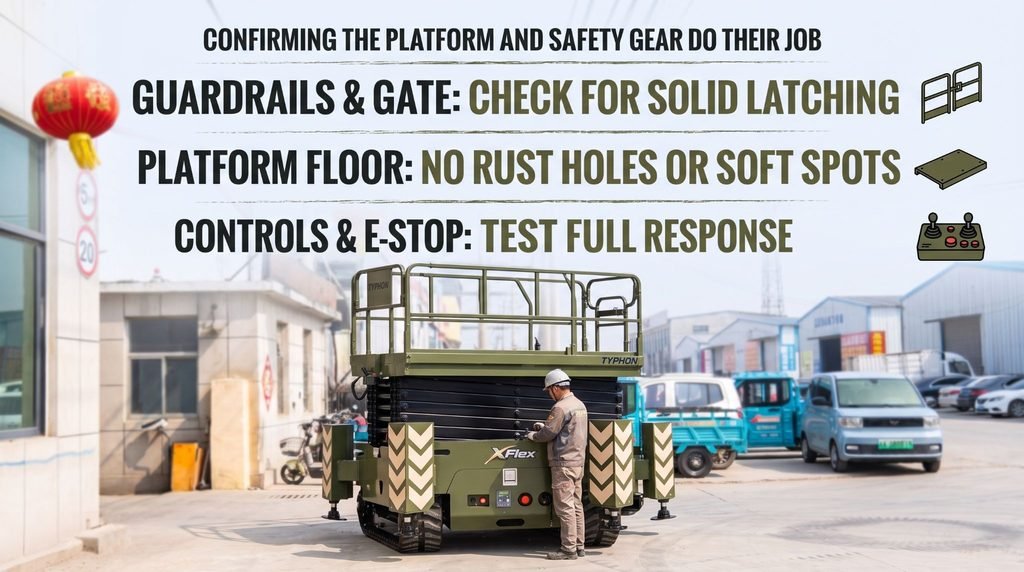
Safety features protect the people the machine lifts, so confirm every one works before you consider buying. Guardrails and toe boards should sit firmly in place without bending or wobbling, the entry gate or chain should latch securely, and the platform floor should carry no rust holes or soft spots. Missing or damaged rails turn a routine lift into a fall hazard.
Controls demand a full test at both stations. Operate the platform controls and the ground controls through their range, confirm the emergency stop cuts power instantly, and check that the emergency lowering valve brings the platform down when you need it. A control that responds slowly or not at all is a defect you can’t work around.
Alarms and interlocks round out the safety check. The tilt alarm, overload sensor, and motion alarms all exist to warn an operator of danger, so verify each one sounds or reacts as designed rather than assuming a quiet machine is a healthy one. Disabled safety devices often mean a previous owner ignored a problem the sensor kept flagging.
What this means: Verify the guardrails, gate, controls, emergency systems, and alarms all function before you buy. Working safety gear protects your crew at height, and any dead or missing feature is a repair you must price in or a deal you should refuse.
Reading the Service Records and Hour Meter
History tells you how a machine was treated, so ask the seller for maintenance records before you talk about the price. A documented trail of oil changes, hydraulic service, and repairs shows an owner who cared for the lift, while a missing history leaves you guessing at everything the machine has been through. Records that line up with the hours give you real confidence in the purchase.
Hour meter readings put the machine’s use in context. A low number sounds appealing, but the hours matter most alongside age and upkeep, since a lift with modest hours and no maintenance can be in worse shape than a well-serviced machine that worked harder. Weigh the meter against the records rather than trusting it alone.
Tampering is worth watching for when the two don’t add up. A meter reading that seems surprisingly low for the machine’s age and visible wear, or a gap in service records that nobody can explain, suggests something isn’t right. If the numbers don’t match what you see with your own eyes, treat that gap as a reason to press harder or walk away.
Key takeaway: Request full service records and read the hour meter against the machine’s condition and age. Documented history and honest numbers protect you from inheriting a neglected lift dressed up to look like a bargain.
Taking the Machine for a Real Test Run
A test run is where everything you’ve inspected either holds up or falls apart, so don’t skip it regardless of how good the machine looks on the ground. Drive the lift across the lot, raise it to full height, lower it, and cycle it through every function the controls offer, since real movement reveals hesitation, noise, and drift that a static look misses. A machine that behaves cleanly under operation is one you can trust.
Battery condition matters on electric models and shows itself under load. A pack that reads full but sags the moment the lift climbs tells you the cells are tired and a replacement is coming soon, so run the machine long enough to feel whether it holds its power through a full cycle. A weak battery is a hidden cost that a short demo never reveals.
Drive performance ties the test to how the machine works on a real site. Confirm it steers, accelerates, and brakes smoothly, check that both drive modes work if the model offers them, and listen for grinding or clunking that points to worn drive motors or wheel hubs. A lift that performs cleanly in every function gives you the confidence a written spec sheet never can.
What this means: Run the machine fully, test every function, load the battery, and listen for trouble before you agree to buy. A thorough test run is the last line of defense between a sound purchase and a repair bill you never expected.
Conclusion
Buying a used scissor lift without overpaying for hidden problems comes down to verifying the machine’s true condition before money changes hands. Start with the frame and scissor arms, looking for cracks, sloppy welds, and worn pivot pins that a fresh coat of paint can’t hide. Test the hydraulics for smooth travel, leaks, and cylinder drift, and confirm every safety feature, from guardrails to emergency stops and alarms, actually works. Review the service records against the hour meter and the machine’s visible wear, and complete a full test run that loads the lift, cycles every function, and reveals performance the lot walk never shows. Work through those checks in order, and you turn a used purchase from a gamble into a confident investment. When you’re ready to put a dependable, well-matched scissor lift to work, reach out to a trusted equipment specialist who can pair a reliable machine with the results your projects depend on.
Frequently Asked Questions
What should I check before buying a used scissor lift?
Start with the structure: examine the frame and scissor arms for cracks, bends, rust, and sloppy repair welds, and check the pivot pins for slop. Move to the hydraulics, running the lift through its full range while watching for hesitation, leaks, and cylinder drift. Confirm every safety feature works, including guardrails, emergency stops, and alarms. Review service records alongside the hour meter, and finish with a full test run that loads the machine and cycles every function. Those checks reveal the real condition a clean exterior hides.
How do I know if the hydraulics on a used scissor lift are failing?
Three signs tell the story. First, rough or hesitant movement while raising or lowering points to a worn pump, low fluid, or air in the lines. Second, visible leaks along the cylinders, hoses, or fittings show a system losing fluid and pressure. Third, cylinder drift, where the platform slowly sinks after you stop the controls, signals worn seals or a failing valve. Raise the platform partway, hold the controls still, and watch for several minutes. A healthy lift holds its height; one with tired seals will not.
Should I ask for service records when buying a used scissor lift?
Yes, always. Service records show how faithfully the previous owner maintained the machine, covering oil changes, hydraulic service, and any repairs. A documented history that matches the hour meter reading gives you real confidence in the machine’s condition, while missing or incomplete records leave you guessing at everything the lift has been through. If the records show gaps, or the hours on the meter seem surprisingly low for the wear you see, treat that as a reason to inspect harder or walk away entirely.